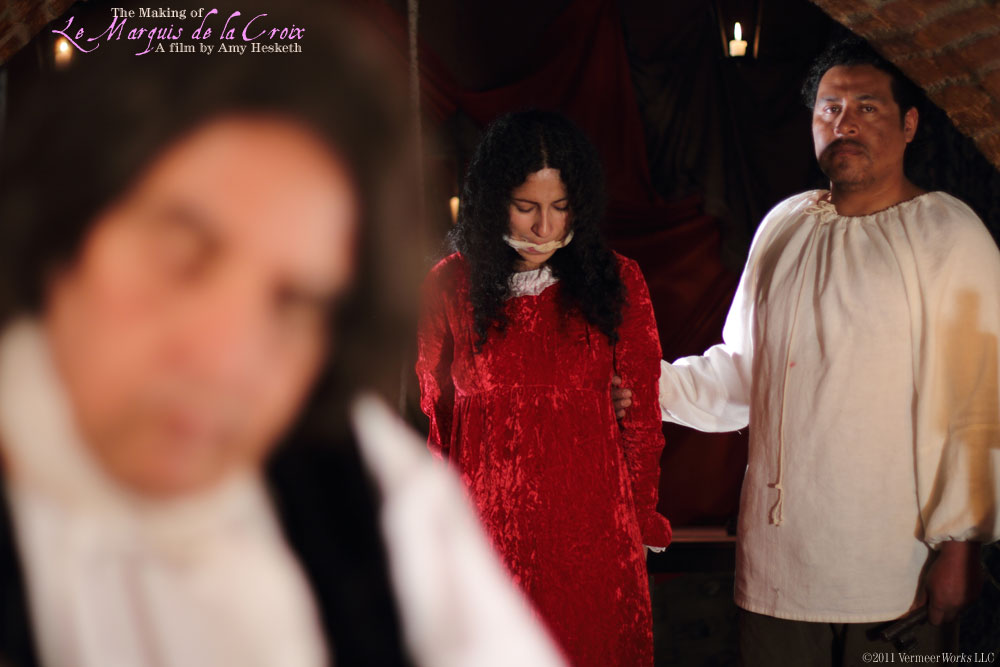
Monday, October 31, 2011

Maleficarum

We released Maleficarum the 31st of October, Halloween, so appropriate.  And what people have been saying on various forums is really heartwarming. Below are a couple of the very first comments, I'll be posting more as I collect them.

Here's an excerpt from one:

Just finished watching "Maleficarum", and I must say that I'm very impressed with the work. The burning at the stake at the end is one of the best ever done, even for more mainstream films. The effects and the acting were superb!

...you won't be disappointed!

Lighting is very well done... There's enough (blood) there to get the message across, without making it look like a bad car accident.

Hopefully the revenue from this movie will be enough to get another one in progress. Maybe next time, the accused really is a witch and casts a spell over the Inquisitor!


And here's another:

Just watched Malificarum download. Amazing. 

The movie was extremely well done and very convincing. Both actresses were really good. Please more movies like this.

To say that I'm pleased is an understatement. We all, crew and actors, really put our hearts and a lot of time and effort into this movie. We labored over the details, and spent months on the post-production making the effects that are now being appreciated.

You can buy the DVD HERE  and Download it HERE

The official trailer:


Thursday, October 6, 2011

Monday, September 5, 2011

La Montaña Interior (The Mountain Inside)*

The cemetery with the Huayna Potosi in back.
It's been a while since I've worked in a film that was directed by someone other than a member of our team, so I was pleased when my friend Diego Torres mentioned that he had a small role for me in his film La Montaña Interior.

The role I play is a tourist who's hiking with her boyfriend, played by Jac Avila, and comes across another hiker, played by Jorge Ortiz. A jealous situation erupts, I assert my right to do what I wish, my boyfriend becomes angry and then I end up chasing after him back down the mountain.

Rocky landscape, getting colder.
In order to film the scenes, which were located at the foot of the glacier on the Huayna Potosi mountain, about 5,300 (~17,400 feet) above sea level, we had to take a car to the foot of the Huayna Potosi and then hike up to the glacier. Our group consisted of myself, Diego Torres, Coca Guerrero, Jac Avila, Jorge Ortiz, and an architect who graciously drove us in his vehicle.

At the refugio, cold.
The car ride was impressive for a few reasons, leaving the city of El Alto, we were witness to a huge opaque cloud of smog hovering over the city. Disgusting. The color of coffee with milk. Anyone who tells you that it's less polluted in Bolivia is a liar. The other impressive view was very simple the beauty of Bolivia, lagunas of vary-colored waters due to algae and mineral deposits, an amazing cemetery at a bend in the road with the backdrop of the mountain, the stark harshness of the Altiplano, peppered with scrub brush, evoking a scene from a Western.

As we arrived at the foot of the Huayna Potosi, a turquoise colored laguna came into view, tapped by a dam on one end. As I was to learn later, the turquoise color comes from the glacier itself, which I'm sorry to say is melting away rather fast due to climate change and will most likely not be with us much longer. So go see it, it's really cool.

Going to shoot down near the turquoise laguna.
We parked near the dam next to the refuge, the Refugio Huayna Potosi, and went in for some hot coffee and a sandwich before we began the ascent to the glacier. We found a group of tourists in the cute little lodge, along with evidence of many other groups that came before, advertising their visit on various scraps of paper, banners, badges and other sundries tacked to the walls of the main room. I could already feel the change in altitude as the refuge is already 4,720 meters (~15,500feet) above sea level.

Crossing the dam.
After the coffee and sandwich, we headed out to shoot a couple of things near the turquoise lake. The wind had picked up. It was cold. But beautiful as we looked over the lake to this huge mountain, blue sky hovering over the snowy peak. After shooting near the lake, we headed over the dam and to the trail up the mountain to the glacier.

The dam was small, but impressive for the view off of the side, which dropped off several hundred meters and poured out into a rocky valley. The height of the mountains here never cease to amaze me. I was in Maine recently and the mountains I thought so high when I was a little girl seem flat now after living in La Paz for almost 6 years. Upon looking out over that view, however, we saw clouds beginning to roll in.

(See glasses).
The trail was relatively easy for an experienced hiker, but the lack of oxygen can be a bit disorienting at times and there's a need to go slowly and steadily up the mountain. If you hurry, you can become light-headed and fall. So, channel your inner tortoise, the hare already fell off the mountain. There were some nice views in various places on the trail, one of which is of a neighboring mountain, Chacaltaya, also snowy-peaked.

After about an hour of climbing we reached the glacier. At last, my burning question as to why the laguna below is turquoise was answered, the glacier is turquoise! It's blue, baby. Amazing. Particularly since I had never seen a glacier. It's icy blue goodness stretched high above us and into a bend in the mountain, where it disappeared from view. I was so taken with this big chunk of ice that I walked up to it and licked it. Thousand year old bacteria? Blueberry flavored? In truth, a bit dirty and it tasted like pretty much any other ice cube. But now I can say I licked the glacier on the Huayna Potosi. And I have a photo to prove it.

Um, yeah, it's awesome.
We set down our burdens and started to shoot. Diego is using black and white Super 8 film for the movie, no sound, in order to get back to his roots, so to speak, when he began making experimental black and white silent films in the '70s. Coolness. It's not easy to find black and white Super 8 film nowadays, I'm pretty sure the sole reason it hasn't died out altogether is courtesy of a bunch of film students and a few die-hard French.

Super 8 film is pretty sensitive, but clouds were coming in as we were shooting and in moments, we couldn't see more than a few meters in front of us. I started getting a bit worried about hiking back down the mountain. A group of hikers stopped on a ledge above us to watch the shooting. One of the scenes I shot was pretty demanding and I was freezing, we had to hurry to get everything done before we couldn't see at all. And before I contracted hypothermia.

At the foot of the glacier.
We shot everything, got momentarily lost on the way down, eventually made it back to the refuge and had some hot quinoa soup. The drive back was in approaching darkness, the cemetery was silhouetted against the sky, and we closed in on El Alto and La Paz with the lights on. I love seeing the lights of a city from above.

Yes, I really did that.
Shooting a movie is always exciting, it never loses its charm, no matter how often you do it. And our team shoots often. Even when you're just making a little piece of a whole, it's fun. And shooting outdoors is especially challenging, climate, weather, and in this case altitude, all play a factor in what you can do out there. But it's a great feeling to defy the elements simply as a human being, and even greater as filmmakers.

My overall impression was one of wonder. Living in a city you tend to forget how much beauty there is in the world. And how much we're affecting it by polluting. I'm not going to get all preachy on you, but it's frightening what you see when you go to a place far out of the city, that logically pollution should not touch, and 'lo, the destruction is right there in front of you. Go visit a glacier before they disappear. Thousands of years old ice. It's amazing. And give it a good lick while you're there.

*If this reads like a travel blog entry, deal with it.

Monday, August 29, 2011

Transformation and catharsis in Jac Avila's Martyr

I've thought a lot lately about what causes a person to transform. I've done some transformation myself recently because of my father having dementia, having to put him in assisted living, deal with his estate. And it also looks like I'll have to be buying a house for my mother soon as well, since hers was not built to last. I've undergone something of an abrupt transformation from child into parent, very quickly, and out of need.

But what causes someone to transform? If they do it out of necessity, what dictates the necessity? Is it a personal need, such as the character of Camille in Jac Avila's Martyr? Or is it something greater than themselves? If it's personal, does that make the transformation narcissistic? And how do we achieve catharsis from transformation?

Martyr is punctuated by photo sessions which provide the structure of Camille's transformation, and Camille's subsequent catharsis. In all of Gabrielle's shoots, we see the camera, the flash, we hear the clicking of the shutter, and the first of Camille's photoshoots has these elements as well. But as Camille approaches Eulalia through her work in the studio, the camera seems to fade from view, the click of the shutter is less frequent, we pass through the veil into Camille's private world, where she is becoming Eulalia, and nothing else matters or exists.

It is here, in that world, where we only hear Camille's breathing, her agony, her cries and pain, and suffering, that her transformation really begins. She distances herself from the other characters and slips from this plane into one in which she relives Eulalia's martyrdom. It is beautiful, ugly, bloody, frightening, and sexy all at once.

We begin as Camille lets herself be disrobed, we see her letting go of herself, the person she pretends to be day in and day out. As she drops to the floor, it is as if she releases her burden. The burden of her soul, her problems with her boyfriend (which are mostly caused by this personal search for fulfillment); the world falls away.

At first, the camera is still present. Suddenly, with the first strike of the wooden stick, Camille begins to know Eulalia, her pain, her suffering. She twists and turns underneath the rod that beats her. The images are like paintings, they are beautiful to behold, and that beauty is emphasized by Camille's contortions, the pain she evokes. Camille takes us along in her journey. The sounds make us flinch, but Camille is using the pain, the experience, for her own ends.

Camille chooses her next ordeal, she is on Eulalia's path, so she must hang from a tree and be raked with a sharp iron claw. In Camille's version she is strung up with her hands spread in the studio. Her hair hangs silky and long, her body taut with tension. Tadeusz moves the claw down the front of her body, leaving behind a trail of blood, Camille screams. When she is taken down she lies very still, the world has not yet returned to her. when she revives, it is with more determination.

Continuing on Eulalia's path, Camille hangs from her ribs. This is mimicked with a chain placed under Camille's arms, her hands are tied behind her back with course rope. The chair is taken away and we see Camille suspended in the dark, her body hangs in blackness, as if she is suspended in the vacuum of space.

In this scene, Camille begins to connect more deeply with Eulalia, she whispers to herself, she wants to see something, she wants the saint to show her something. She wears an expression of deep spiritual striving. The chain cuts into her skin so deeply that she bleeds, causing concern and wonderment in Tadeusz and Elisa. Camille strives for something tangible, she wishes for the pain to bring her something. In moments, we forget about the image-making, the click has ceased, Camille swings in space, hanging by a spiritual thread.

The progression continues when Camille is tied to the X-cross. She challenges Tadeusz in this moment, by telling him that she has her period, that in fact, the blood is running down her leg and that she wants him to use it on her body, like make-up effects. He puts his finger in her blood and she takes it into her mouth, asking for him to kiss her. In this moment she shows that this fight for catharsis is hers alone, selfish and perhaps narcissistic. She is trying to transform what her boyfriend shies away from (the blood), into something daring and revolutionary.

As they continue the session, Camille's figure taut with tension, her legs look fragile, but the strain in her muscles and tendons evokes strength, resistance. She uses the pain to reach Eulalia, to force Eulalia into her body. To coerce a revolution in herself. She is coming into being.

In the story it wasn't over for Eulalia, and thus, it's not over for Camille. She plans to follow this road to the very end. As Eulalia was turned upside down on the X-cross, so is Camille. The next day her tense body hangs from her ankles, her ribcage forming a hollow. And into that hollow, Elisa pours hot wax from a tall red candle, simulating the hot oil that was poured onto Eulalia. Again, Camille shows her hand, who she's really doing this for. She tires of the game, she's cranky and ends the transformation, even before it has begun this time. She leaves, saying that it's over.

But something is happening within Camille. Her transfiguration is affecting those around her, is affecting her. She shows that she doesn't know what is happening to her. She expresses doubt in what she is doing, and then a new strength enters her, she leaves her boyfriend. She separates herself from the one who is holding her back, Julien, and goes back to the facilitators of her transformation, Tadeusz and Elisa.

Camille returns to more pain. Eulalia's pain and her own. She is tied with her arms over her head and whipped.

The final photo shoot is the last act of Camille's passion play, her ultimate effort to fully become Eulalia. We see her nailed to the cross, writhing, spitting blood, a dove finally rising from her mouth. There is no snap of the camera, but we're so horrified, or mesmerized, by what we're seeing that we don't really notice the absence of the shutter. The end, the resolution, the catharsis is happening. Camille becomes... herself.

When we change, we transform. The simple passing of time can do it, we see the evidence in the mirror, but sometimes it's internal, a deep need, a necessity, an urgency to become who we really are, regardless of anything or anyone else. And while we may think that personal striving for catharsis and change is narcissistic, the self is more complex than that. The people around us are affected, but can also be inspired. Changing ourselves may make us fit into the world in a different way, but maybe we fit a little better.


Martyr is available on DVD and for Download HERE!

Monday, August 8, 2011

Life is not all roses sometimes...

but it always gets better! Right?!

I'm back from a grueling six weeks of dealing with family issues and the estate issues that go along with that. My dad has dementia. I know, it's really sad, but I've tried to take the opportunity to develop a different relationship with him and remember the good times we had. Today I sent him a postcard, one of many. I hope he likes it.

So, onward and upward! I got back to the office to find a rough cut of Barbazul. I really like what I see, it needs a lot more editing work, but it's a very powerful film, and very good looking. I'm really excited about that. And was pretty surprised, since my absence meant that everyone else had to do my work as well as their own for the past six weeks.

The subtitles of Sirwiñakuy appear to be finished, we just need to put them on the film and voilá, it shall be released very soon on VermeerWorks, and some time after that on Amazon. Hooray!

Maleficarum is plugging along, we were hoping to have a release date by now, but it's a complicated film, with a complicated structure to edit, lots of effects, visual and sound, and so, it'll just have to take the time it takes. Good things do take time.

And Le Marquis de la Croix will have to wait for the others to be edited. We seem to have a backlog of movies to edit, which is a good thing, but leads to some impatience...

All in all, I've accomplished a lot in the past six weeks, and now that I'm back to work, where I'm happiest, I'm looking forward to everything we have planned, future releases and new productions! Stay tuned.

Monday, May 30, 2011

More about the photoshoot scenes in Martyr

The last time I only talked about the photoshoot scenes in Martyr involving Gabrielle, played by Veronica Paintoux. Now, I'd like to say a little about the photoshoot scenes involving Camille, played by Carmen Paintoux.


There is a certain moment in Martyr when Camille becomes the subject of Tadeusz's camera, played by Jac Avila, and Gabrielle feels pushed aside. He decides to divert from his usual style and to try something more involved with Camille. Gabrielle resents that he sees something in Camille that he does not see in her. There is something in Camille that Gabrielle simply cannot give.


In a way, we see these two women through Tadeusz's lens. We see what they give to him, that they give their bodies to make images, but they also use him to develop a part of themselves, a symbiosis. The scenarios that he makes for them, and the scenarios that the women make later on, are part of how they wish to see themselves, or perhaps also how they wish to be seen.

We do not sense in the movie that Gabrielle is merely a model, but rather that she is someone who wants to see herself as a beautiful image. Gabrielle's choice of clothing in other scenes of the movie, when there is no camera on her, speak of how she wishes to be perceived. And also connote that she is not a Puritan, they speak of her freedom, of her possessing libertine values.


Tadeusz makes it plain in the movie that he finds his inspiration from his models themselves, through his constant question and answer sessions, through his "education" of his model's by watching documentaries, research and looking at other images. By observing how they react to stimulus.


What he sees in Gabrielle and what he sees in Camille are different personalities entirely. But he views them as sources of, rather than objects of, creativity.

When we first see Camille from the perspective of Tadeusz's lens, it is with some of the same seductive qualities that we have seen before, with Gabrielle, but Camille brings a different sort of seduction to the images. There is something grittier, another kind of sexy. Tadeusz introduces iconic elements of sadomasochism; a blindfold made of red silk, he then uses the same red silk to tie Camille's hands together.


Later on in this shoot, we get a little closer to the theme Camille and Tadeusz develop later on in the film. In the image, she is straining toward the camera, we sense that in this moment, Tadeusz sees this special something in Camille, her arms spread, she looks like she might rise up off the floor and fly, yet her hands seem as if nailed to the very floor. Her expression is angelic, yet speaks of mortality, the fragility of humans.


So, what does this mean? I can tell you what it means to me, what it has meant to me.

Most overpowering is the feeling that we're there, that we're part of these moments, that the actresses are looking at us, that they're giving themselves to us. Which they are, because the act of giving is very strong in Martyr. Carmen and Veronica give a lot in this film. Something that I found, and still find every time I watch it, incredibly inspiring, so much so that I try to give more every time I act. It is in the act of giving myself to the viewer that I myself am freed.

Martyr can be found on DVD, and very soon as a download HERE!

Wednesday, May 25, 2011

A Second Trailer of Martyr

Here's a longer trailer of Martyr, enjoy!


Martyr is available on DVD HERE!

Sunday, May 22, 2011

The photoshoot scenes in Martyr

I'm not a person who watches the same movies over and over again savoring the details and finding new things with each viewing. But I've done just that with Martyr. I've seen it in 3 different theaters, on DVD, and even almost frame by frame helping Jac to subtitle.

There are elements that I savor every time I see this movie, and I'll try to talk about them one at a time. The first is the photography sequences with Gabrielle, played by Veronica Paintoux.


One of the 3 subplots in Martyr revolves around Tadeusz, a photographer played by Jac Avila, and his model, Gabrielle. The lighting, the way the imagery is presented, each photo shoot is presented in a different way. Just as it would be in a real photo-shoot.

In the first shoot the lighting is darker, more blue, mysterious, Veronica looks like the sexy bohemian libertine from times gone by, but at the same time rooted in the contemporary. Her expressions draw something from the viewer,
they tell you to look at her, to enjoy what you see. The texture draws you in, you can almost smell the make-up, feel the heat of the lamps. The camera draws close to her, we feel like we're part of this glamorous moment, that we don't want it to end. The scene seduces us. This seduction is key to the seduction of the movie as a whole.

The second photo-shoot is lighter, brighter, white and colors flying, we see how fun this is; grown-ups playing like children. Again, Veronica looks into the camera, embracing the moment, reaching out and grabbing us. There's a visceral feeling that comes to the forefront. The moment is so beautiful,


we're there, we're part of this beauty. Almost as if we're making her do these fantastical things, like we're the photographer drawing these expressions out of her, and not the other way around.

I love beautiful images. For me, a beautiful image is something a bit rough, imperfect. It makes the illusion stronger. For instance, I'm a fan of Terry Richardson's photos. And the images created in these movie photo-shoots in Martyr have that quality, something real: the reality of illusion.


We see glimpses of how this illusion is made, but there's something else that we're not seeing; it's a movie and there are people behind another camera.

And still more behind those, watching this delicious movie.

Martyr is available on DVD HERE!

Wednesday, May 18, 2011

Jac Avila: El primer avance de Barbazul, toda una pequeña ave...

Since I'm too stressed out to blog today, I'll share this. It's all about me anyway. Cool beans.


Jac Avila: El primer avance de Barbazul, toda una pequeña ave...: "Jac Avila es Barbazul Un lunes que quedó en el pasado, en la mañana, estaba decidido a cortar un clip con escenas de Barbazul . La noche..."

Tuesday, May 17, 2011

The DVD Release of Martyr!


I'm very enthusiastic about announcing that Martyr is now available on DVD at VermeerWorks.

Now the whole world can see the film that changed the very direction of my life. I'm extremely proud of my co-conspirator and the director of Marytr, Jac Avila, for releasing this wonderful movie. It is truly a labor of love and the result is a film that is simply stunning a shocking. Yes, shocking, I'm still shocked after seeing it 5 times.

Sometimes someone creates something that is so powerful and so close to them that it touches you. It reaches right out and gets into your soul, it affects the way you see the world, and other people. That's Martyr.

Martyr is available right now in two versions, one with English subtitles, and another version with Spanish subtitles. Since the spoken languages of Martyr are French, English and Spanish, those who don't speak all three will want a DVD with subtitles.

And... very, very soon Sirwiñakuy will be available in the same store. at vermeerworks.com!

Tuesday, May 3, 2011

That's a wrap...again!

It's my birthday today and I've been thinking a lot on everything that's happened in the past year, the wonderful people I've met online, in real life, and finding the talented people I work with. The cooperation and encouragement I've received from friends, collaborators and fans has helped me to achieve my goals this past year!

I just wrapped on my third movie as writer/director, Le Marquis de la Croix, and I'm looking forward to shooting my next movie soon. Barbazul is being editing and Sirwiñakuy is being released this month on DVD and download. Incredible!

It has been a year of growth and learning for me and I am grateful to be alive right now, in this moment and doing the things I really want to do.

Sometimes life feels like an uphill battle, fears hold us down and get in the way of our goals and dreams. But this birthday, I feel that I have to try more than ever to realize my dreams.

So, more about Le Marquis de la Croix, which we wrapped on Saturday April 30th. We had a very long day shoot, from 10AM until 8PM. I love days like that, when at the end, you're incredibly tired and you've finished something. You feel like you've really accomplished something. In this case, my third movie.

The last shot we did was very complicated, but Miguel Canedo, cinematographer extraordinaire, pulled it off with his usual excellence. It's just a really super shot to end the film. Of course I can't tell you what it is, you'll have to see the movie.

Mila Joya, the star of Le Marquis, was amazing, she completely understood my concept, and she put up with all of the nasty things I had for her character, like eating bread off of the floor. Can I just repeat how awesome she is?! Every time I work with her it's a great experience, I can't imagine making a movie without her!

Some parties will get after me for making a movie like Le Marquis. They're going to be angry because a woman is making a campy "exploitation" film, in the footsteps of Jess Franco, Roger Corman, Jean Rollin, and others. Personally I feel that there could be more campy post-modern "exploitation" movies, films that have a little fun with the dark side, that don't take themselves so seriously. That go just a bit farther than their predecessors.

The support that I've received for this concept has been astounding. Thank you all!

Saturday, April 16, 2011

Decadent Cinema

So, June 15th we began production of my third film as writer/director, Le Marquis de la Croix. Very exciting stuff. For some time now I've been planning to begin shooting in earnest, lots of films, campy films, exploitation films, serious films. Well, it looks like this is it. The time has come! With The Marquis, we're beginning a new era.

The Marquis de la Croix, produced by Decadent Cinema, is a more campy exploitation film based on the writings of the Marquis de Sade (who else?). I could go on about the post-modern need for post-modern exploitation films, a la Jess Franco, Roger Corman, Jean Rollin, etc., or I could simply say that I'm making the films that I wish I could find in the "weird films" section of my local video store.

The Marquis de la Croix will be in Spanish and English, with subtitles in several languages.

So far I'm extremely pleased with the movie as I've looked over the rushes each day. It's so amazing to have such a great team of talented people to work with. They help me to take an idea and make it a reality. An extremely beautiful reality.

Friday, April 8, 2011

The premiere of Martyr


The premiere of Martyr went swimmingly Wednesday night, April 6th. Afterward, I had a hard time shaking off the tension that I get when I see the movie. In fact, this is the fourth time I've seen Martyr, the first being in 2005 in the film festival "Diablo de Oro" in Oruro, Bolivia.

When I first saw the movie it impacted me in a way that changed the very direction of my life. I loved the story, the acting, the cinematography, the music. Really, I loved it all. I loved it so much that I decided to drop everything in my life, stay in Bolivia and make movies with the director, Jac Avila.

From this incredible movie came the beginning of my life as a film director. I saw that one could make personal movies, beautiful works of art, living paintings, and with very little money. Something that I simply didn't think was possible before seeing this movie. It was the best movie that I had ever seen that was filmed on digital, and not even HD, because HD didn't exist yet. I believe that this movie is a revolution for cinema simply from that fact, being filmed in digital video, from which the result is nothing but pure beauty.

It is a sign to all of us that one can produce movies, personal movies, movies that we care about, which before wasn't possible with 35mm. Every time I see Martyr it makes me think about how lucky I am to be working with Pachamama Films and making works of art using the medium of cinema.

And then there's the story. A story that I think is universal. Today we had a meeting of our cast/crew whom we regularly work with and one of them went on and on about how the message of the film touched him, how he respected and identified with Camille in her journey to develop this "thing" that she has inside of herself. He talked about how he knows so many men and women who have fantasies, dreams, and who don't do anything about them. Their dreams remain dreams for the rest of their lives, because they're too afraid to take them from deep inside of themselves and show them in the light of day, or to others. I hope that with us, he is able to make his hopes and dreams a reality, that we can all make our creative fantasies into realities together as a team.

There is something in the character of Camille that speaks to all of us. The fear of rejection, the need to part of something, but at the same time to feel special. The feeling that we have something to offer the world.

For me, the moral of the story in Martyr is that we should show our true selves to others, regardless of whether or not anyone likes it, because there will be some that do like you for who you are, and those are the people you want to know.

Today was a day to just sit back and see how extremely lucky I am to be in a group with such wonderful, creative, talented individuals.

And to think about my next movie...

Friday, April 1, 2011

A Critique of Martyr in English and Spanish

What follows is the first critique of Martyr. I find it insightful and very well written and think that it's my duty to share it with you.


The first presentation of Martyr was at the University of Connecticut by invitation of the professor Dr. Gigliotti. The audience were students of Cinema and literature.

On of those students sent Jac Avila a letter containing his impressions. It was the first critique that Martyr received.


Concerning the feature film you showcased for our Film and Literature class.

I thought I would give you at least one person’s humble opinion.

I am fascinated by artistic visions. An artist myself, I am always intrigued to see one’s passions brought to life, that progression of intention, strife, and outcome. Clearly, your film is a labor of love. There is a line delivered fairly early on in the movie, something to the effect, “You’ll appreciate freedom when it’s taken away from you.” The line stuck with me because, in Camille’s case, I found it to be just the opposite. Her entire journey is in pursuit of freedom, something she obviously lacks; although the methods she chooses in procuring it are certainly interesting ones: she forsakes a relationship of stability and love for one of uncertainty and torment. That these turn into a sort of liberation speaks volumes about a deeply affected psychology. She is quite the interesting character, to say the least.

Personally, I am drawn to religious commentaries and the unholy marriage of pain/pleasure, both of which are sprinkled liberally throughout your film. I feel the strongest parts of the work, however, are the ones that deal with neither. I am speaking of the one on one conversations between Dave and Julian, Camille and Tadeusz, etc.; their rumination of everyday living, love and loss keep the work grounded. (They also inject some humor into otherwise dire matter.) Here the humanity, the universality of painful existence, is allowed to shine. That isn’t to say I don’t feel the graphic scenes are unsuccessful. To the contrary, the “one on ones” are effective precisely because of their juxtaposition with depictions of animalistic impulses and cruelty. You cut from such bloody, ghastly extremes back to delicate interactions seamlessly. In short, I feel it is this balance of convention/excess, love/hate, acceptance/rejection that propels the film along.

While I am not that acquainted with the story of Eulalia, I am still able to appreciate Camille’s quest, the lengths she is willing to go to feel fulfilled. Many, no doubt, will find such lengths disturbing. I don’t see them as all that divorced from the lengths the artist takes to deliver his or her creations to the masses. Anything worth creating tends to stem from hardship, heartache, woe, and suffering. I mean, I’ve written a lot of songs and painted a lot of pictures, and I don’t recall a damn one of them coming from an abundance of happiness.

In any event, I want to thank you again for having allowed us to participate in the film’s first screening. I wish you much success with its distribution and festival showings. Take care.

Sincerely,

Joe Clifford

(Version en Español)

La primera presentación pública de Martyr fué en la Universidad de Connecticut por invitación del profesor de cine Dr. Gigliotti. La audiencia eran sus estudiantes de cine y literatura.

Uno de los estudiantes se dió la tarea de enviarme sus impresiones. Esta es la primera crítica que recibió Martyr.

Sobre la película que mostraste a nuestra clase de Cine y Literatura.

Pense que por lo menos puedo darte la humilde opinión de una persona.

Me fascinan las visiones artísticas. Como artista, siempre me intriga ver como uno lleva a la vida una pasión, esa progresión de la intentión, la lucha y el resultado. Ciertamente, tu pelicula es una labor de amor. Hay un párrafo en el diálogo bastante temprano en el film, algo así como: “Se aprecia la libertad cuando te la quitan”. Esa linea se me quedó porque, en el caso de Camille, he visto que es lo opuesto. Todo su recorrido es en busca de libertad, algo que obviamente no tiene: aunque los métodos que elige para encontrarla son realmente interesantes: deja una relación de estabilidad y amor por un camino incierto y lleno de tormento. El hecho que eso se convierte en un tipo de liberación dice volúmenes sobre una psicología profundamente afectada. Ella es un personaje interesante, es lo mínimo que se puede decir.

Personalmente me atraen los comentarios religiosos y la impia unión entre el dolor y el placer, ambos liberalmente repartidos en todo tu film. Pero pienso que las partes mas fuertes del trabajo, sin embargo, son aquellas que no tienen que ver con ninguno de esos puntos. Me refiero a las conversaciones uno a uno entre Dave y Julien, Camille y Tadeusz, etc.; sus reflexiones de la vida diaria, el amor, la perdida mantienen el trabajo bien fundado. Tambien inyectan algo de humor en un asunto terrible. Aquí la humanidad, la universalidad de una existencia dolorosa, sale a relucir.

Lo que no quiere decir que las escenas gráficas no funcionen. Al contraro. Los uno a uno son efectivos precisamente por la yuxtaposición con representaciones de impulsos animales y crueldad. Tú cortas de tan sangrientos y horripilantes extremos a las interacciones delicadas sin ningún problema. En resumen, siento que es este balance de convencional/exceso, amor/odio, aceptación/rechazo es lo que empuja al film hacia delante.

Aunque no estoy familiarizado con la historia de Eulalia, todavía puedo apreciar la busqueda de Camille, los extremos a los que está dispuesta a llegar para sentirse completa. Muchos, sin duda, verán estos extremos inquietantes. Yo no los veo tan alejados de los extremos a los que un artista llega para llevar sus creaciones a las masas. Cualquier cosa que merece ser creada, tiende a surgir de las dificultades, angustias, lamentos, sufrimientos. Me explico, he escrito muchas canciones y he pintado muchas pinturas y no recuerdo ninguna maldita de ellas emergiendo de una abundancia de felicidad.

De cualquier manera, quiero agradecerte nuevamente por permitirnos participar de la primera presentación de la pelicula. Te deseo exitos con la distribución, festivales y presentaciones. Cuidate.

Sinceramente,

Joe Clifford